
Categories
start here, market update, neighborhoods, relocation, new constructionPublished October 30, 2026
Kansas City Suburbs Moving in Opposite Directions (2026)

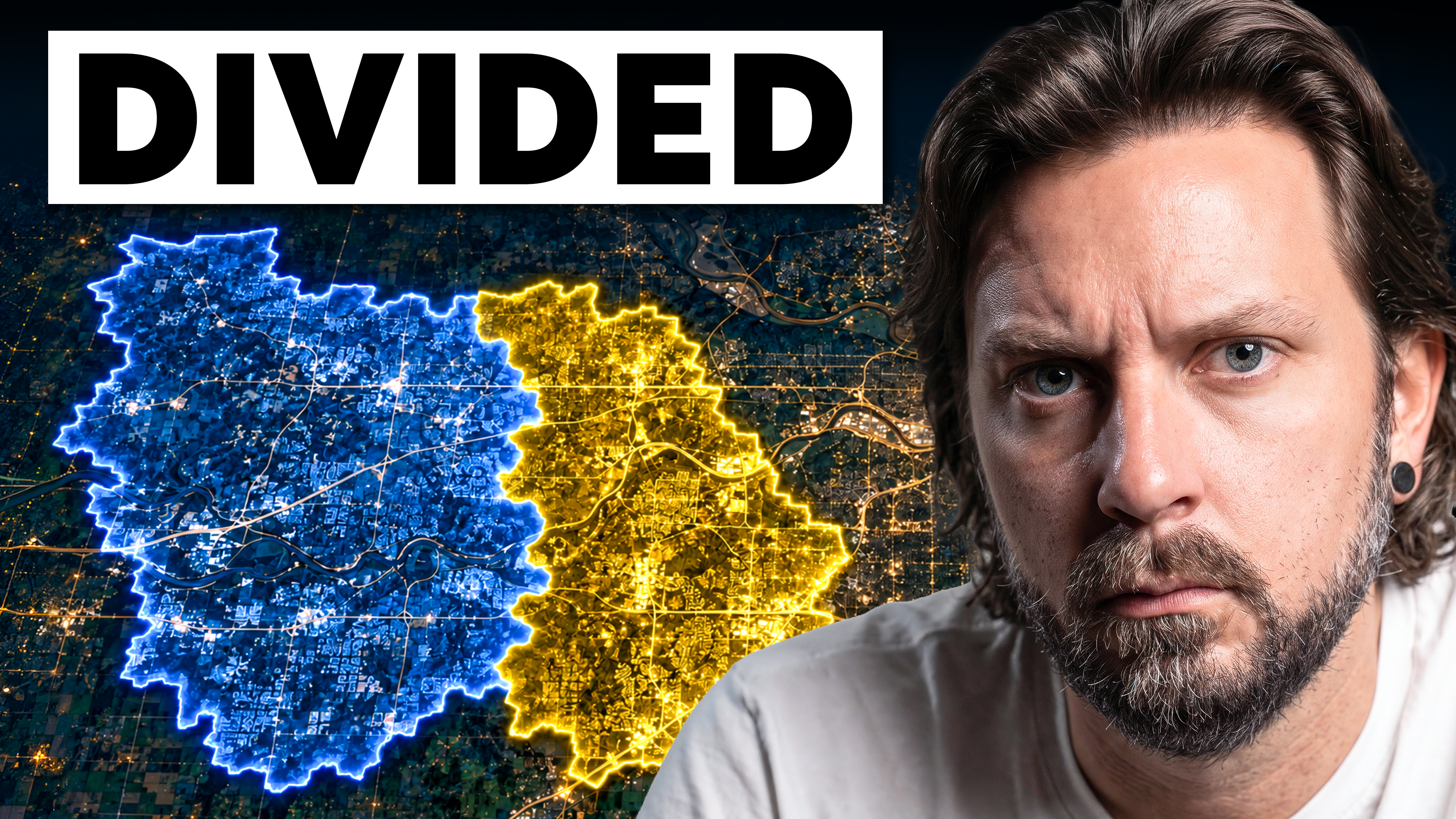
Kansas City Suburbs Moving in Opposite Directions (2026)
In one part of the Kansas City metro, homes are flying off the market in days. In others, they're sitting for nearly a month and prices are coming down. (Prices-coming-down claim is Kyle's market commentary; needs Kyle review before publish.)
I recently had a listing in Parkville. It's a seven-year-old, one-and-a-half-story home:
- Nearly 4,500 square feet
- Four bedrooms, four and a half bathrooms
- Finished walkout basement
- Screened-in porch, backs to trees
It was listed for $789,000. That's a lot of money. But if I picked that exact house up and dropped it into Leawood, Prairie Village or certain parts of Overland Park, we'd be talking about a $1.2 to $1.3 million house. Maybe more, depending on exactly where you put it.
In Parkville, we struggled to get it sold. Heck, we struggled to get showings.
That sent me down a bit of a rabbit hole. When I started looking at what's happening across the Kansas City metro, I noticed how the market in one suburb can be entirely different from another town 20 minutes away.
I'm Kyle with Moving to KC. My team and I work with buyers and sellers all over the metro. In this post, I'm looking at which Kansas City suburbs actually have momentum right now, which ones are changing, and why some appear to be heading in completely different directions. That means a combination of what I'm seeing in the housing market, where new homes are being built, where commercial development is going, how much land is left, and what buyers are actually willing to pay for location.
The Fast Answer: Which Kansas City Suburbs Have Momentum?
Growth and a hot housing market are not the same thing in Kansas City. Built-out suburbs like Prairie Village (2-day median days on market) and Mission (4 days) sell fastest because there's almost no land left. Overland Park, Olathe and Lenexa combine established demand with room to keep building. Fast-growing Spring Hill (41 days) and De Soto (about 4.7 months of supply) have softer resale markets because new construction adds supply, and Parkville (26 days) has a thinner luxury buyer pool. The better question isn't "what's the hottest suburb?" It's what stage of growth you want to live in.
Kansas City Suburb Housing Market Snapshot (2026)
Here's what the MLS data I pulled shows for the 12 months leading into fall 2026. "n/a" means that figure wasn't part of my breakdown.
| Suburb | Median sale price | Median days on market | Months of supply | Sales (last 12 months) |
|---|---|---|---|---|
| Prairie Village | ~$515,000 | 2 | ~1 | n/a |
| Mission | n/a | 4 | Under 1 | 182 |
| Overland Park | ~$510,000 | 5 | Under 2 | Almost 2,700 |
| Leawood | n/a | 5 | n/a | n/a |
| Olathe | n/a | 9 | ~2.3 | 2,300+ |
| Lee's Summit | ~$408,000 | 15 | Just over 2 | 1,800+ |
| Independence | ~$216,000 | 20 | Just over 2 | 1,800+ |
| Parkville | ~$610,000 | 26 | ~2.1 | n/a |
| Spring Hill | n/a | 41 | ~3.4 | n/a |
| De Soto | n/a | n/a | ~4.7 | 102 |
| Gladstone | ~$276,000 | n/a | Under 1 | n/a |
| Liberty | ~$378,000 | n/a | ~1.9 | n/a |
Why Growth and a Hot Housing Market Aren't the Same Thing
One of the first things I noticed going through the numbers: a suburb can be adding thousands of people and hundreds of new homes and still be a tougher place to sell an existing house. Another suburb can be almost completely built out and have homes selling in two or three days.
Prairie Village: Scarcity Drives a 2-Day Market
Prairie Village may be the best example of that. Over the last 12 months:
- Median days on market: 2. Two.
- Housing supply: about one month
- Median sale price: around $515,000
Here's the thing about PV: there is basically nowhere to grow outward. The streets exist. The neighborhoods exist. Most of the lots have had houses on them for 60, 70, sometimes 80 years.
So when somebody wants to move into Prairie Village, you're not waiting for a developer to open another 300-lot subdivision. Somebody who already owns a house has to sell one.
That scarcity has changed the way Prairie Village grows. It grows through:
- Renovations
- Additions
- Teardowns
- Infill
People buy a relatively modest older house because they want the location, then put hundreds of thousands of dollars into it. Prairie Village is not growing outward anymore. It's growing in value.
Mission: Northeast Johnson County Without Prairie Village Pricing
I've seen that same trend start to take shape just north of Prairie Village in Mission. (One of my clients gave me a hard time recently because she said I never talk about Mission. So here you go.)
Mission is tiny compared with Overland Park or Olathe. There were only 182 closed sales there over the last year. But:
- Median days on market: 4
- Housing supply: under one month
What's interesting about Mission is that it still has pockets where you can get into northeast Johnson County without paying Prairie Village pricing. I sold a client a brand-new home there for around $900,000. It's a beautiful house. Move that same new house a few miles south into Prairie Village and we'd easily be talking about $1.3 to $1.4 million.
Same general part of the metro. Very similar proximity to the Plaza, downtown, Brookside and the rest of northeast Johnson County. Completely different value assigned to the location.
That's one of the biggest things people underestimate about housing. You're not just buying bedrooms and bathrooms. You're buying a location that has its own supply and demand. Mission is experiencing some of the same scarcity dynamic as Prairie Village, just without quite the same pricing premium.
Overland Park, Olathe and Lenexa: Established Demand Plus Room to Grow
Drive south and west, and Johnson County changes completely.
Overland Park
Overland Park may be the best example in Kansas City of a suburb that has managed both established demand and continued growth. Over the last year:
- Home sales: almost 2,700
- Median days on market: 5
- Housing supply: under two months
- Median sale price: around $510,000
Those are strong resale numbers for a city that big. What makes Overland Park different from Prairie Village is that it's enormous. The northern part of OP has been built out for decades. Keep driving south and the houses get newer, the roads get wider and the subdivisions get bigger, until you reach parts of Overland Park where new construction is still very much part of the market.
You effectively have several different versions of Overland Park inside the same city. That gives it something Prairie Village doesn't have: room.
Olathe
Olathe has a similar story:
- Home sales: more than 2,300 over the last 12 months
- Median days on market: 9
- Housing supply: around 2.3 months
Unlike northeast Johnson County, there's still a lot of land farther west and south where development can continue.
Lenexa
Lenexa has intentionally built entirely new commercial and residential centers over the last couple of decades. Lenexa City Center is the most obvious example; that whole area looks nothing like old Lenexa. Then you have the K-10 corridor running through western Johnson County, with continued employment and industrial investment pushing development farther west.
Overland Park, Olathe and Lenexa have a different type of momentum. They already have established demand, but they still have places to put new houses.
Parkville: More House, Thinner Buyer Pool
Which brings me back to Parkville. On paper, Parkville has a lot going for it:
- Beautiful terrain and trees
- Great neighborhoods
- Easy airport access
- Larger homes and larger lots than you can generally get in northeast Johnson County
At the higher end, I'd argue you can get dramatically more house for your money. But the market tells you buyers don't value the two locations equally.
Over the last 12 months, Parkville had a median sale price of around $610,000, actually higher than Overland Park as a whole. It had about 2.1 months of supply, so it's not buried under inventory. But the median days on market was 26.
Compare that with:
- Overland Park: 5 days
- Leawood: 5 days
- Prairie Village: 2 days
- Mission: 4 days
That's an enormous difference in liquidity, and it gets at something months of inventory doesn't capture very well: buyer depth. There simply aren't as many people shopping for an $800,000 home in Parkville as there are shopping for an $800,000 home in Johnson County.
That doesn't mean the Parkville house is worse. In a lot of cases, it's objectively more house: bigger, newer, more land, more privacy. But at some point, the buyer decides what percentage of their budget goes to the house itself versus the location. And Johnson County has built up an enormous location premium:
- Employment centers
- Shopping and restaurants
- School-district demand
- Healthcare
- Established neighborhoods
- Familiarity for relocation buyers
Once enough people want the same area, that demand starts feeding on itself. Parkville has a thinner luxury buyer pool, so at higher price points a seller can have an incredible property and still wait longer for the right buyer. That's a very different market from Prairie Village, where the bigger problem is simply finding a house to buy.
Spring Hill, De Soto and Gardner: Fast Growth, Softer Resale
There's another category of suburb I think is even more interesting: places that are growing quickly, but where the resale market is actually softer.
Spring Hill
People have been moving farther south in Johnson County for years. Spring Hill still has plenty of developable land, new subdivisions keep opening, and you've got access toward Olathe and Overland Park to the north as the southwest Johnson County corridor keeps pushing outward.
But look at the resale numbers:
- Housing supply: about 3.4 months
- Median days on market: 41, one of the longest market times of any suburb I pulled
If everybody's talking about growth, why aren't houses flying off the market? Because growth creates supply. A homeowner selling a five-year-old house in Spring Hill isn't just competing with the house next door. They're competing with a builder, who might be offering:
- A brand-new house
- A warranty
- Closing-cost incentives
- Potentially a rate buy-down
- The ability to choose finishes
So one of the fastest-growing places in Kansas City can actually be a tougher place to sell an existing home than a suburb with almost nowhere left to build. That's why using home-price appreciation alone to identify the "hottest suburb" misses so much of the story.
De Soto
De Soto is another extreme example. There's been enormous attention on De Soto because of Panasonic and the development happening around that corridor. But it's still a very small housing market:
- Homes sold in the last 12 months: 102, based on the MLS data I pulled
- Current listings: 40
- Housing supply: roughly 4.7 months
With a market that small, I wouldn't draw huge conclusions from a single snapshot; a few listings can move the numbers dramatically. But it reinforces the point: economic development does not instantly turn into a hypercompetitive resale housing market. Those are different things.
Gardner
Gardner is farther along in that evolution. It still has available land and new construction, but its resale numbers are considerably tighter than Spring Hill's right now.
These southwest Johnson County markets are going to be fascinating to watch over the next decade, because this is where much of the metro still has room to physically expand.
Lee's Summit vs. Independence: Same Speed, Different Price Points
Cross State Line, and Lee's Summit may be the Missouri-side suburb that most closely resembles the established-growth model. Over the last 12 months:
- Home sales: more than 1,800
- Median sale price: around $408,000
- Median days on market: 15
- Housing supply: just over two months
You've got an established downtown, large employment and retail areas, lake communities, older neighborhoods, brand-new subdivisions, large custom homes and entry-level housing. It's a broad market, and Lee's Summit still has room to grow.
What makes this interesting is the comparison with Independence right next door. Independence had almost the exact same number of home sales over the last year (more than 1,800), supply is also just over two months, and median market time is 20 days. If I showed you only market velocity, you wouldn't say these two places are going in opposite directions.
Then look at price:
- Lee's Summit: around $408,000
- Independence: around $216,000
Almost half. That difference reflects decades of completely different housing and development patterns. Independence has a much older housing stock, less large-scale high-end residential development, and serves a different buyer pool. Lee's Summit has spent decades adding new neighborhoods, new retail centers and higher-priced housing farther out.
"Opposite directions" doesn't always mean one is booming and the other is collapsing. Independence clearly still has buyers, and houses are still selling. But the type of housing being created, the price point and where new investment is going look very different. Sometimes that difference is exactly what a buyer wants: if affordability is the priority, a $220,000 median market offers something a $400,000 market simply cannot.
The Northland Isn't One Market
The Northland is another place where people use one giant label for several completely different markets. You'll hear, "The Northland is booming." Broadly, sure, there's a lot happening north of the river. But Parkville is not Liberty. Liberty is not Smithville. Smithville is not Kearney. Gladstone is not Kansas City North.
- Gladstone: under one month of supply, median sale price around $276,000
- Liberty: around $378,000, roughly 1.9 months of supply
- Kearney and Smithville: both above two months of supply
- Parkville: over $600,000, with a much thinner upper-end buyer pool
There's definitely momentum north: available land, new subdivisions, commercial and industrial development, and proximity to KCI. But "Northland growth" does not mean every Northland suburb behaves the same way.
The Real Driver: How Much Land Is Left
The thing tying almost all of these places together is land.
- Prairie Village: no land, so the market creates scarcity
- Mission: same basic problem, at a different price point
- Overland Park: the northern portion is mature while development continues farther south
- Spring Hill: tons of land, so builders keep adding supply
- The Northland: still huge areas where the metro can continue expanding
When a suburb has land, growth generally means more rooftops, roads, retail, schools and subdivisions. When it runs out of land, growth changes form: remodeling, redevelopment, density, infill, teardowns and appreciation.
Neither one is automatically better. They just create completely different experiences for homeowners.
What Is the Hottest Suburb in Kansas City?
I'd be really careful with that question. What does "hot" mean?
- Fastest population growth?
- Fastest home sales?
- Most new construction?
- Biggest price appreciation?
- Most commercial development?
- Lowest inventory?
Those could all give you different answers. If you're thinking about moving here, the better question is: what stage of growth do you actually want to live in?
- Prairie Village: you're buying scarcity. You'll probably get an older house and less square footage for your money, in a location where there isn't much more housing that can ever be created.
- Overland Park or Olathe: you can find established neighborhoods and still have access to parts of the market that are expanding.
- Spring Hill, Gardner or De Soto: you may be getting in much earlier in the development cycle. That can mean newer houses for less and more room for the area to change around you. It can also mean construction, more competition from builders and a community that looks very different ten years from now.
- Parkville: you might get significantly more house for the money than in Leawood. But when it's your turn to sell, your pool of buyers may not be nearly as deep.
- Independence or Raytown: you can still find price points that basically don't exist anymore in Johnson County.
Those are all legitimate tradeoffs.
The Bottom Line
Kansas City is not growing evenly. Some suburbs are expanding. Some are becoming scarce. Some are reinventing themselves. Some offer value specifically because buyer demand hasn't pushed prices to the same level. And some of the places getting the most new development aren't necessarily the easiest places to sell a house today.
Going back to that Parkville listing: the takeaway isn't that Parkville is heading in the wrong direction. Far from it. Two suburbs can offer similarly high-quality housing and still have completely different economics, because buyers assign enormous value to location. Those differences are probably only going to become more noticeable as Kansas City keeps expanding. (Forward-looking market commentary; needs Kyle review before publish.)
Frequently Asked Questions
Which Kansas City suburb sells homes the fastest?
Prairie Village, with a median of just 2 days on market over the last 12 months and about one month of supply. Mission (4 days), Overland Park (5 days) and Leawood (5 days) are close behind.
Why do homes in Spring Hill take longer to sell?
Spring Hill had a 41-day median days on market and about 3.4 months of supply. With plenty of developable land and new subdivisions opening, resale sellers compete with builders offering brand-new homes, warranties, closing-cost incentives, potential rate buy-downs and the ability to choose finishes.
Why are Parkville homes sitting longer than Johnson County homes?
Parkville's median days on market was 26, compared with 5 in Overland Park. Parkville isn't oversupplied (about 2.1 months), but it has a thinner luxury buyer pool. Fewer people are shopping for an $800,000 home in Parkville than in Johnson County.
Is De Soto's housing market hot because of Panasonic?
Not on the resale side yet. De Soto had 102 sales over the last 12 months and 40 current listings, roughly 4.7 months of supply. It's a small market, so a few listings can move the numbers, but economic development doesn't instantly create a hypercompetitive resale market.
How do Lee's Summit and Independence compare?
Both had more than 1,800 sales over the last year and just over two months of supply. Lee's Summit's median days on market was 15 and its median sale price around $408,000; Independence was 20 days and around $216,000.
Is the Northland one housing market?
No. Gladstone has under one month of supply and a median around $276,000. Liberty is around $378,000 with about 1.9 months of supply. Kearney and Smithville are above two months. Parkville is over $600,000 with a thinner upper-end buyer pool.
What is the hottest suburb in Kansas City?
It depends on what "hot" means: population growth, sales speed, new construction, appreciation, commercial development or low inventory can each point to a different suburb. A better question is which stage of growth fits what you want from a home.
Find the Kansas City Suburb That Fits Your Stage of Growth
If you're thinking about making a move here and trying to figure out which suburb fits your budget, the type of house you want and the lifestyle you're looking for, this is what my team and I do every day. Reach out at movingtokc.net/info or email us at info@movingtokc.net.
Watch next: Kyle's video on what Kansas City residents really think about living here.
Related reading: What Kansas City Residents REALLY Think About Living Here · Kansas City's Most Undervalued and Overvalued Suburbs in 2026 · Avoid Moving To Johnson County Unless You Can Handle THESE Things · What $500,000 Buys You In Kansas City's BEST Areas
Source: MLS data as referenced by Kyle Talbot, 12-month figures as of fall 2026. Figures are approximate.

Kyle Talbot
Owner + Agent + Waldo Mayor + KC Hype Man | Moving to KC | KW Kansas City Metro
or another way