
Categories
neighborhoods, development, economyPublished October 9, 2026
Kansas City's $1.5B Country Club Plaza Plan, Explained (2026)

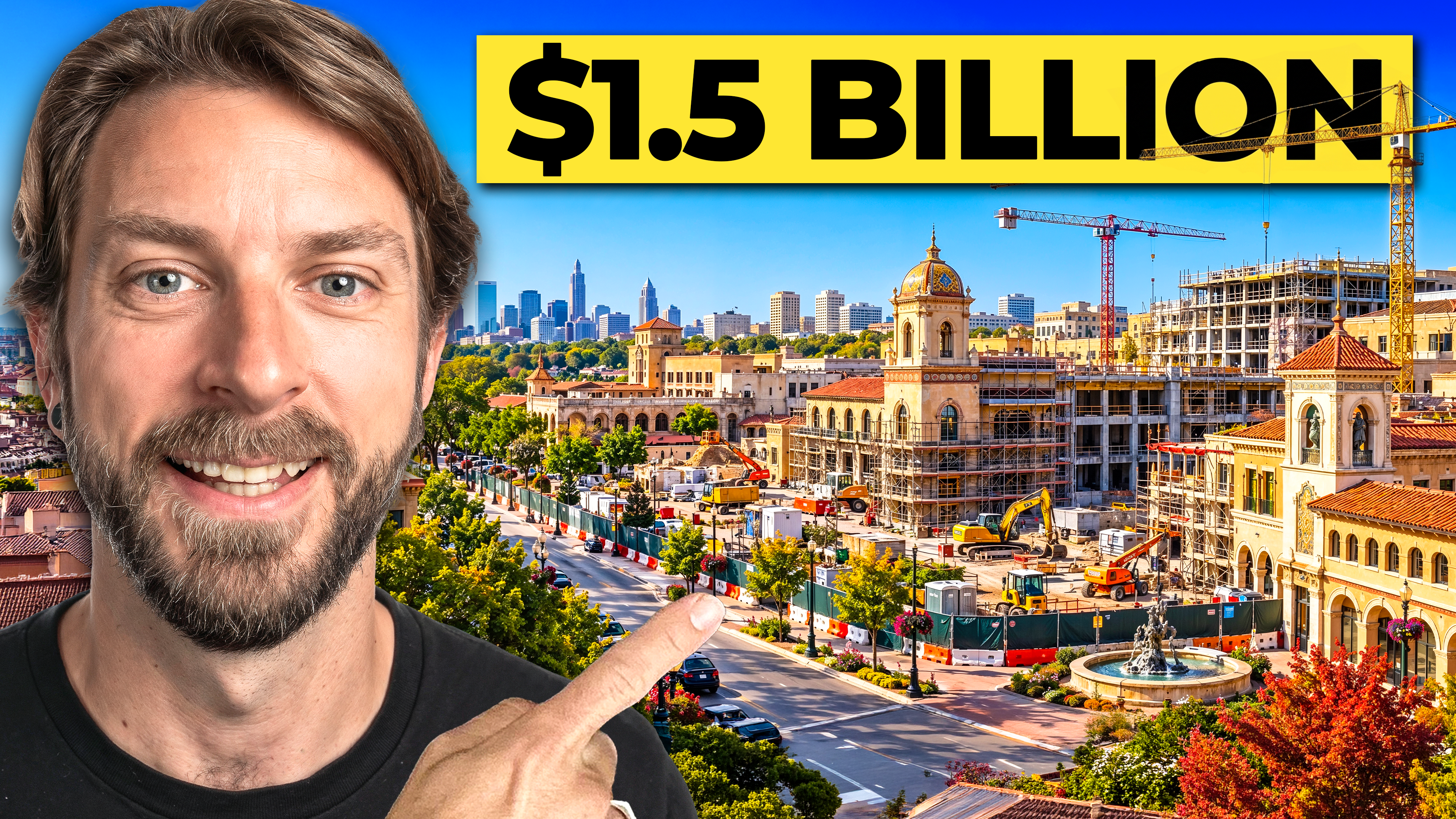
Kansas City's $1.5 Billion Plan to Save the Country Club Plaza (2026)
Kansas City just approved a $1.5 billion plan to save the Country Club Plaza. But there's more to it than the headline.
- There wasn't a $1.5 billion check cut.
- The city didn't borrow $1.5 billion.
- There isn't even a guarantee the full redevelopment ever gets built.
What Port KC actually approved was a financing framework that could support up to $1.5 billion worth of development over roughly the next 15 years, and every phase still has to come back for approval.
Underneath that headline is a bigger story. The Plaza that comes out the other side of this could look very different from the one Kansas City has known for the last 100 years: hundreds of new apartments, taller buildings, major public improvements, significant tax incentives and a much more residential version of the Plaza.
I'm Kyle with Moving to KC. I'm a local realtor, and my team and I work with buyers and sellers all over the metro. If you're trying to make sense of where Kansas City is growing and what it could mean for where you live or where you're thinking about buying, this is a lot of what we do.
The Fast Answer: What Is the $1.5 Billion Country Club Plaza Plan?
The $1.5 billion Country Club Plaza plan is a long-term redevelopment framework, not a $1.5 billion public payout. Kansas City approved a Master Planned Development zoning framework for the Plaza in May 2026, and on August 24, 2026, Port KC approved its intent to issue conduit bonds that the developer, not taxpayers, is responsible for repaying. The $1.5 billion is a ceiling for total investment over about 15 years. Each phase still needs its own plan, financing approval and permits. The vision includes more than 1,000 new residential units, roughly 1.7 million square feet of commercial and retail space, hotels, public-space improvements and taller buildings on selected blocks.
What Actually Got Approved?
There are two separate approvals behind the headlines.
1. The zoning framework (May 2026). Kansas City approved a new zoning framework for the Plaza called a Master Planned Development. Think of it as the rulebook for what can eventually be built there. It lays out land use, building heights and the broader vision for how the district can develop.
2. The Port KC vote (August 24, 2026). This is the vote that generated the $1.5 billion headlines. Port KC approved its intent to issue bonds and to keep working toward a master agreement with the Plaza's ownership group.
This deal has been kicking around for a while. Port KC tabled an earlier version in late 2025 while negotiations continued, and by the August vote, the plan had gone through close to a year of revisions.
Every Phase Still Has to Come Back for Approval
This piece matters. The August vote didn't approve $1.5 billion worth of bonds all at once. Before construction starts on any phase, the developer has to:
- Bring forward a final development plan for that particular phase
- Get the specific financing for that phase approved by Port KC
- Go through the normal permitting process
The $1.5 Billion Is a Ceiling
That $1.5 billion is essentially the maximum the developer could invest if the entire project gets built out over the life of the plan. It is not $1.5 billion that has already been borrowed, spent or handed over by taxpayers.
What Are Conduit Bonds?
The financing is different from what most people assume when they hear "bonds." These are conduit bonds. Port KC issues them, but the developer is responsible for paying them back. Port KC's own financial statements make that distinction.
So no, Kansas City did not hand a private developer $1.5 billion. But the city did create a path for a redevelopment that could eventually reach that size.
Why the Plaza Needs This: How Much Value It Has Lost
$1.5 billion starts sounding a little less crazy when you look at what has happened to the Plaza itself. For all the nostalgia around it, the numbers are not great.
- The Plaza has lost close to half of its appraised value since 2020.
- Roughly one-third of the storefront and office space is vacant, according to the current ownership group.
- The current owners bought it in 2024 for about $175.6 million. Back in 2016, the Plaza sold for $660 million. That's a staggering drop in less than a decade.
If you spend time down there, you probably don't need an appraisal to know something has been off. I live in Brookside, about five minutes from the Plaza, and there are stretches where it doesn't feel like the Plaza I remember from 10 or 20 years ago. More dark storefronts. Fewer people walking around during parts of the week. Businesses that were there forever have disappeared.
Aging Infrastructure
The problems aren't limited to empty retail. The Plaza also has:
- Aging water lines
- Sewer infrastructure needs
- Parking garages that need major investment
Lockton's Planned Move to Leawood
Then there's the office side. Lockton has been one of the Plaza's major employers for about 25 years, with roughly 1,500 local employees working from its offices there today. Lockton has announced plans to build a new headquarters in Leawood that's expected to open in 2030.
They're not leaving tomorrow. But when you're looking at a redevelopment that could take 15 years, losing a major employer like that absolutely matters.
This isn't a story about filling a few empty storefronts anymore. The Plaza needs investment. The bigger question is what kind of Plaza comes out the other side.
What the New Country Club Plaza Could Look Like
The plan isn't simply to bring back the old version. It's trying to change how the district works by turning the Plaza into a much denser mixed-use district.
| What's in the plan | Details |
|---|---|
| New residential units | Over 1,000 |
| Commercial and retail space | Roughly 1.7 million square feet |
| Hotels | Part of the mix |
| Public-space improvements | Wider sidewalks, improved crosswalks, more bike infrastructure, pocket parks |
| Building heights | Much of the Plaza stays relatively low-rise; selected blocks could support much taller buildings than exist today |
| Timeline | Roughly 15 years, approved phase by phase |
In short: more people living there, more density, more mixed-use development, more pedestrian infrastructure, new commercial space, potential hotel development and taller buildings concentrated in certain parts of the district.
Some of the public-space ideas are described in the planning documents as aspirational. Don't assume all of those improvements are happening next year. This is a long-term plan.
Why the Residential Piece Matters Most
I think the residential piece is one of the most important parts of the entire plan.
Historically, the Plaza has been somewhere people drive to. You go for dinner. Maybe you shop. You go to the Plaza Art Fair or to see the lights. Then you get back in your car and leave.
Retail districts work differently today than they did 30 or 40 years ago. If you want shops, restaurants and services to survive throughout the week, it helps to have people who live nearby and use those businesses on a Tuesday morning or a Wednesday night.
The Streetcar Changes the Equation
The KC Streetcar extension now runs from the Riverfront through downtown and Midtown to UMKC, with a stop right at the Plaza. That means hundreds of new residents could walk downstairs, grab food, go shopping, jump on the Streetcar and get all the way downtown without getting in a car.
That's a very different Plaza, and there's a lot to like about it. If you spend much time on the Plaza now, you know how much space is still devoted to moving and storing cars. Taking some of that space and making the district more comfortable to walk could be a major improvement.
What's Still Missing: A Grocery Store
One thing I'd love to see is a legitimate grocery store. If we're adding hundreds of apartments and trying to make the Plaza somewhere people live day to day, being able to buy groceries without driving over to Brookside would make a lot of sense.
The Height Debate: Up to 275 Feet at the Old Nordstrom Site
Adding that many residents means adding density, and that gets into the most sensitive part of this plan: height.
For generations, the Plaza has stayed low to the ground because of the Plaza Bowl overlay. Across much of the district, buildings have historically been limited to 45 to 130 feet. That low profile is a huge part of the Plaza's character. You get the towers, architecture and fountains, but you don't feel like you're walking through downtown.
Contrary to some of the concern out there, that lower scale isn't disappearing everywhere. Several blocks will keep it. But other blocks now have significantly more room to go vertical.
Under the approved plan, the tallest allowable building could reach up to 275 feet at the long-abandoned Nordstrom site along the western edge of the district. That's roughly the scale of a 20-story downtown building, next to a district that has spent most of its history below five stories.
Allowed Is Not the Same as Built
- There is not a 275-foot tower under construction right now.
- There isn't even a final project at that height that has been approved.
- What the city approved is the ability for a future developer to propose something that tall on that block. That project would still need its own approvals.
Both Sides of the Height Question
This is where the real debate around the Plaza's future is going to live, and both sides have a point.
The case for it:
- The Plaza needs investment.
- More residents should help support retail.
- Density makes sense next to the Streetcar.
- Concentrating height on selected blocks is more thoughtful than changing the scale of the entire district.
The case for caution:
- Once those buildings go up, they're there. You don't get the old skyline back.
- The challenge is figuring out how much change you can introduce before the thing you're trying to save stops feeling like the thing people cared about in the first place.
Who Pays? Tax Incentives and Kansas City Public Schools
Taxpayers aren't responsible for repaying the conduit bonds, but that doesn't mean this redevelopment comes without public incentives. This is where Kansas City Public Schools (KCPS) has pushed back.
KCPS spent about 10 months involved in negotiations before the Port KC vote. After the vote, Superintendent Dr. Jennifer Collier said the deal was better than what the district was originally presented with in late 2025, but that it still did not fully meet the district's requests.
Here's the basic structure:
- Payments instead of traditional property taxes begin in 2027.
- Guaranteed base payments over the life of the agreement are expected to total more than $234 million, according to the city. Those payments increase over time rather than staying flat.
- An estimated $46.5 million is tied to additional value created as new buildings come online.
- Combined, the city projects more than $281 million eventually flowing to schools and other taxing jurisdictions.
Some of that depends on the project actually getting built, and that distinction matters for something scheduled to unfold over 15 years.
So this isn't as simple as "taxpayers are giving the developer $1.5 billion." They aren't. But you also can't look at a redevelopment receiving this level of tax treatment and say there's no public cost or public interest involved. There is, and that's why the school district negotiations matter.
The city is making a bet: giving the project room to redevelop now eventually creates a healthier Plaza with more property value, more businesses, more residents and a stronger tax base. Whether that bet pays off depends on what actually gets built.
What the Plaza Redevelopment Could Mean for Nearby Neighborhoods
Whatever happens on the Plaza does not stay on the Plaza.
West Plaza
West Plaza has gone through a ton of change over the last decade or so, with older homes torn down and replaced by much larger new construction. In my opinion, two things are working against that market right now: (Kyle's market commentary: needs Kyle review before publish)
- Uncertainty around the Plaza. When buyers are spending serious money that close to a district going through this much change, they want to know what they're buying next to.
- Developers overbuilt the top end. A lot of $1 million-plus homes were built in West Plaza, and I don't think the depth of demand was ever strong enough to absorb that much luxury inventory consistently.
You can absolutely sell a million-dollar home in West Plaza. The question is how many buyers are willing to spend that kind of money there at the same time, and over the last couple of years, I think developers found that ceiling.
So the slowdown there isn't purely about the Plaza. It's a combination of broader market conditions, uncertainty around the Plaza and pricing pushed beyond what the neighborhood could comfortably support. A clearer redevelopment plan should remove at least one of those question marks.
Brookside, Ward Parkway and the Country Club District
Brookside, where I live, has its own identity, its own restaurants and its own shopping district. People don't move to Brookside solely because it's five minutes from the Plaza. But a healthy Plaza nearby is part of the amenity package. The same goes for the neighborhoods along Ward Parkway and throughout the broader Country Club District, which have stayed desirable even while the Plaza struggled.
I'm not telling you that if the redevelopment succeeds, everybody's home value jumps 20 percent. Real estate doesn't work like that. But turning a struggling commercial district into a busier mixed-use neighborhood with more residents, better public spaces, new restaurants, renovated infrastructure and direct Streetcar access changes what it feels like to live nearby. And if the opposite happens, and the Plaza keeps losing tenants and major employers, that matters too.
The Bottom Line
This is one of the most important development stories in Kansas City right now. The city is trying to take one of its most recognizable places, one that clearly needs investment, and modernize it without wiping away what made people care about it.
Personally, I want more people living there. I want the storefronts filled back up. I want the Plaza to feel busy on a Wednesday night again. I'd love better sidewalks, better public spaces and a grocery store. I also don't want to look back in 20 years and realize we saved the economics of the Plaza but lost the Plaza itself.
That balance will come down to what gets proposed phase by phase. The framework may be approved, but a lot of this story hasn't been written yet.
Frequently Asked Questions
Did Kansas City give the Country Club Plaza developer $1.5 billion?
No. Port KC approved its intent to issue conduit bonds that the developer is responsible for repaying. The $1.5 billion is the maximum total investment if the full project is built out over roughly 15 years, not money borrowed, spent or handed over by taxpayers.
When was the Country Club Plaza redevelopment approved?
Kansas City approved the Master Planned Development zoning framework in May 2026. Port KC voted on August 24, 2026, to approve its intent to issue bonds and continue working toward a master agreement with the Plaza's ownership group.
Who owns the Country Club Plaza?
The current ownership group bought the Plaza in 2024 for about $175.6 million. The Plaza previously sold for $660 million in 2016.
How tall can buildings on the Plaza be now?
Much of the Plaza stays relatively low-rise, and several blocks keep their historic scale. Under the approved plan, the tallest allowable building could reach up to 275 feet at the former Nordstrom site on the western edge of the district. No building at that height is under construction or approved as a final project.
How many apartments are planned for the Country Club Plaza?
Current plans call for over 1,000 new residential units, along with roughly 1.7 million square feet of commercial and retail space and hotels.
How does the Plaza deal affect Kansas City Public Schools?
The developer will make payments instead of traditional property taxes beginning in 2027. The city projects more than $234 million in guaranteed base payments plus an estimated $46.5 million from new development, for more than $281 million to schools and other taxing jurisdictions. KCPS Superintendent Dr. Jennifer Collier said the deal improved during negotiations but still did not fully meet the district's requests.
Does the KC Streetcar go to the Plaza?
Yes. The streetcar extension runs from the Riverfront through downtown and Midtown to UMKC, with a stop at the Plaza.
Is Lockton leaving the Plaza?
Lockton, a Plaza employer for about 25 years with roughly 1,500 local employees there, has announced plans for a new headquarters in Leawood expected to open in 2030.
Thinking About Living Near the Plaza?
This is what my team and I do every day. We work with buyers and sellers all over Kansas City, including Brookside, West Plaza and the neighborhoods surrounding the Plaza. If you're thinking about making a move, or trying to figure out what all of this could mean for a property you already own, reach out at movingtokc.net/info or email us at info@movingtokc.net.
Watch next: Kyle's video breaking down how much it costs to live comfortably in Kansas City, including a study claiming a family of four now needs around $230,000 a year.
Related reading: How Kansas City's New Streetcar Is Transforming the City Forever · Everything New & Coming SOON to Kansas City in 2026 · KC's Most Undervalued and Overvalued Suburbs in 2026 · Kansas City's Housing Market Just Sent Its First Real Warning Sign Going Into 2027
Sources: Port KC, City of Kansas City, Kansas City Public Schools and the Plaza's ownership group, as referenced by Kyle Talbot.

Kyle Talbot
Owner + Agent + Waldo Mayor + KC Hype Man | Moving to KC | KW Kansas City Metro
or another way