
Categories
development, economy, neighborhoods, relocationPublished August 28, 2026
The $10 Billion Data Center Boom Taking Over Kansas City

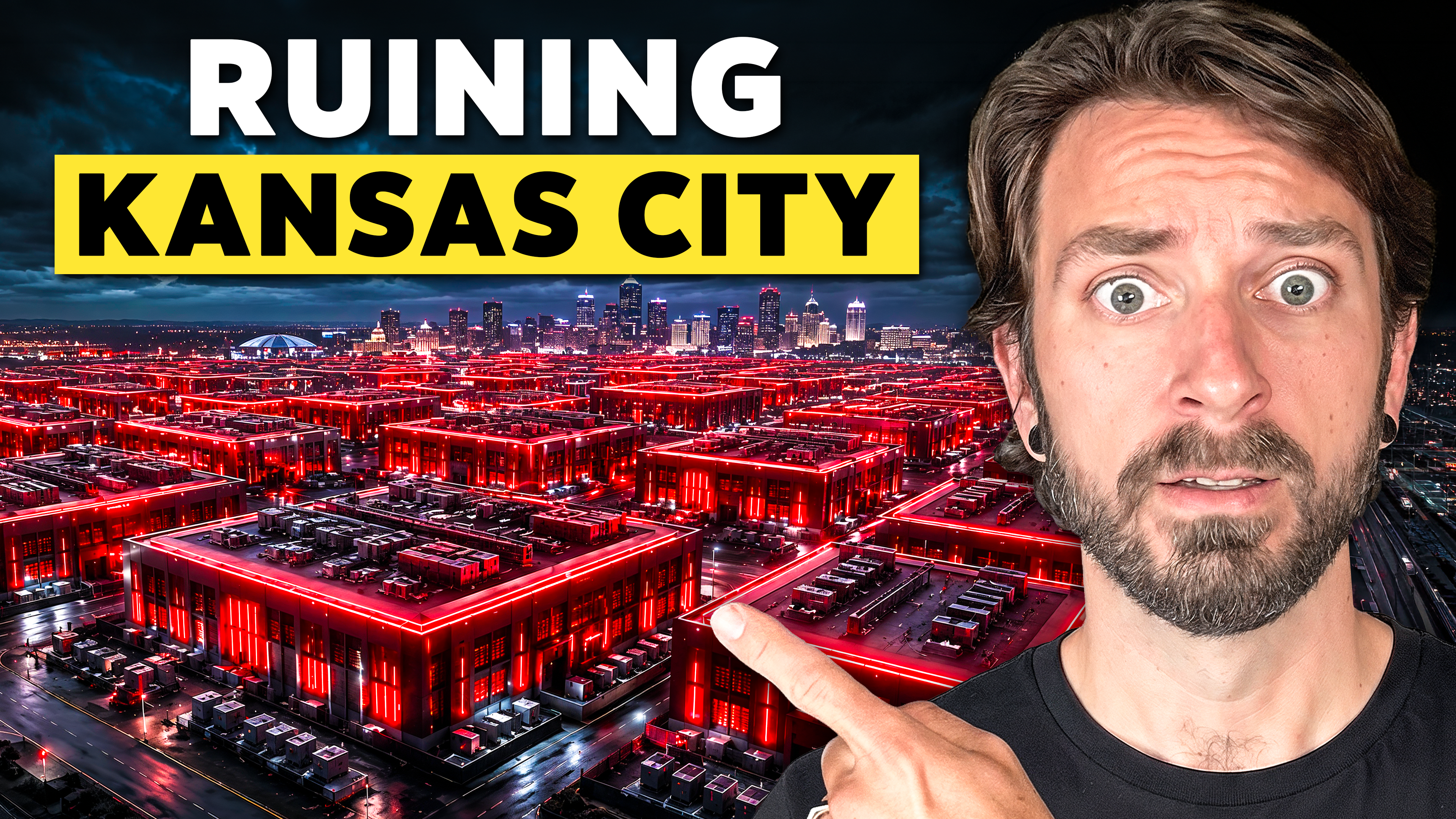
The $10 Billion Data Center Boom Taking Over Kansas City: What It Means If You're Buying a Home Here in 2026
When you buy a home, you're not just buying the house. You're buying everything that gets built around it over the next twenty years.
And right now in Kansas City, what's getting built around some of those houses is unlike anything this metro has seen. Google. Meta. A Dutch AI company called Nebius. Google's Project Mica alone carries a $10 billion price tag — one of the largest private investments in Kansas City history — and it's one of at least 50 data centers operating, under construction, or proposed across the metro.
At first, almost everyone read this as an unambiguous win. Big tech was choosing Kansas City. Construction was booming. The investment numbers were staggering.
Then people started asking harder questions. How many permanent jobs do these facilities actually create? Who pays to expand the power grid? How much water do they use? And what happens to the neighborhoods that suddenly find themselves next door to one?
I'm Kyle with Moving to KC. My team helps people buy and sell homes across this metro every day — relocators coming in from out of state and locals who already live here. This story matters for both groups. Here's what's actually been built, why Kansas City became an AI infrastructure hotspot, what the real tradeoffs are, and what it means if you're buying or selling near any of it.
The Fast Answer: What the Kansas City Data Center Boom Means for Homebuyers
At least 50 data centers are operating, under construction, or proposed across the Kansas City metro, representing tens of billions of dollars in investment. They create thousands of well-paid construction jobs — construction was the metro's fastest-growing employment sector in 2025 — but only about 100 to 130 permanent jobs per campus. The unresolved questions are who pays to expand the electric grid, how much water the facilities use, and how close they end up to existing neighborhoods. If you're buying in the Northland, eastern Independence, or southwest Johnson County, pull the city's approved development map before you make an offer. That's the single most useful thing you can do.
Why Kansas City Became a Data Center Hotspot
This wasn't random. Kansas City has quietly become one of the best places in the country to build large-scale data centers.
Part of it is national — AI has created an explosion in demand for computing power, and companies are racing to build the infrastructure to support it. But Kansas City brought real, specific advantages:
- Geography. The metro sits almost at the geographic center of the country, with low natural-disaster risk compared to coastal markets.
- Fiber. Kansas City is served by 11 of the top 13 long-haul fiber providers in the United States, according to KC SmartPort.
- Power and land. Electricity here has historically been relatively affordable, and there's still large, contiguous, developable acreage — increasingly rare in established data center markets.
- Kansas tax policy. In 2025, Kansas lawmakers passed Senate Bill 98, a 20-year state and local sales tax exemption for data center projects investing at least $250 million. Qualifying projects must also create 20 full-time Kansas jobs within two years, sign a 10-year electricity purchase agreement, and submit a water conservation plan.
Put it together and Kansas City moved to the top of a lot of site selection lists.
The Projects That Tell the Story
Meta — Golden Plains Technology Park, KC Northland
Meta announced an $800 million campus in the Northland in March 2022. By the time it came online in August 2025, the final investment was roughly $1 billion for about 1 million square feet near I-435 and U.S. 169. Around 1,500 workers were on site during peak construction. It employs roughly 100 people permanently.
Google — Hunt Midwest Business Center, KC Northland
Google broke ground in March 2024 on a $1 billion campus east of I-435 near Worlds of Fun. It's still under construction, with roughly 1,000 construction workers on site.
Google — Project Mica, far Northland
Before the first one was finished, Google confirmed a second: Project Mica, a $10 billion, 500-acre campus at the I-435 and U.S. 169 interchange, inside the Smithville School District. Google committed $1.5 million to Smithville schools and $250,000 to the Northland Career Center, paid up front. Construction is underway; Google's facilities typically run 18 to 24 month schedules.
Nebius — AI Factory, eastern Independence
The most contentious of the group. Nebius, a Dutch AI infrastructure company, broke ground on May 12, 2026 on a $6.6 billion, 398-acre campus near Route 78 and Little Blue Parkway — about 2.1 million square feet at full build-out.
The number that changed the conversation was the power. Phase 1 needs 225 megawatts. The full build-out target is 1.2 gigawatts. For scale: the Blue Valley Power Plant that Independence is rebuilding to serve it generated 90 megawatts before it closed in 2020, and won't reach 1,100 megawatts until 2029.
Nebius projects 130 permanent jobs, about 1,200 construction jobs, and $650 million in tax payments to local taxing jurisdictions over 20 years.
Beale Infrastructure — De Soto, Kansas
On the Kansas side, next to the Panasonic battery plant, California-based Beale Infrastructure won approval for a $3 billion hyperscale campus on 300 acres at 103rd Street and Edgerton Road. The De Soto Planning Commission approved it in April and May 2026, and the approved project nearly doubled from the original concept — from 1.14 million square feet to almost 2.9 million. Construction began in April 2026.
Step back and this isn't five separate announcements. It's an entirely new industry taking shape across the metro, on both sides of the state line.
The Jobs Question
This is the part that surprises people most.
The construction jobs are real, and they're good. Union electricians, pipefitters, equipment operators, laborers — many working six-day weeks with annual earnings well into six figures. Kansas City's construction sector grew 9.3% in 2025, the largest growth of any sector in the metro, in a year when the region lost about 3,600 jobs overall.
The permanent jobs are far fewer. Meta's $1 billion campus employs roughly 100 people. Nebius projects about 130. Google hasn't released final staffing numbers, but facilities like these operate with small teams relative to the investment.
Those aren't bad jobs. Google data center technician roles in Kansas City advertise starting salaries around $67,000, and many require a trade certification or associate degree rather than a four-year degree. Solid careers. There just aren't many of them.
That's the part a lot of people didn't understand at the start. A billion-dollar manufacturing plant and a billion-dollar data center don't create the same number of long-term jobs. They're different economic models, and communities deserve to understand the difference before deciding what they're comfortable supporting.
How Independence Became the Turning Point
When Nebius announced its campus, a lot of Independence residents felt they were hearing about a project that had already been decided. A group called Stop the AI Data Center in Independence formed in early January 2026 and grew fast.
The tax package is what lit the fuse: a 90% property and equipment tax abatement over 20 years, representing roughly $6.26 billion in foregone taxes, against a projected $651.5 million in payments in lieu of taxes. The council approved it in March 2026 over sustained public objection.
Then came the election. On April 8, 2026, voters ousted the council members who backed it. At-large member Bridget McCandless lost the mayor's race to Kevin King by more than 20 points after winning the February primary by 17. At-large member Jared Fears lost his reelection bid by a wide margin. Two data center critics won council seats.
Whether you agreed with the opposition or not, the result was unambiguous: people wanted more transparency before projects of this scale moved forward. And Kansas City isn't alone — communities from Virginia to Utah to North Carolina are asking the same questions. Those aren't anti-growth questions. They're planning questions.
Who Pays for the Power?
Evergy asked the Missouri Public Service Commission in February 2026 for a 14.9% increase — $137.9 million — for Missouri Metro customers. If approved, the average residential customer would pay about $17.70 more per month starting in January 2027.
Evergy's position is that residential customers are not subsidizing data centers. The filing states plainly that "no costs to serve data centers are included in this case," and the company created a Large Load Power Service Tariff requiring customers with 75+ megawatt demand to pay a premium rate. Evergy also reduced its request by $25 million based on anticipated data center revenue.
The counterargument isn't about direct service costs — it's about the grid itself. Someone still has to pay to build new transmission lines and generating capacity. Geoff Marke of the Missouri Office of Public Counsel told reporters in August 2026: "If the proper cost allocation is not in place there, then yes, I do think residential customers will be exposed more than they otherwise would be." His office describes transmission infrastructure as a huge cost ultimately borne by ratepayers.
Missouri lawmakers have passed consumer-protection legislation aimed at keeping data center load off residential bills. The honest answer today is that nobody knows exactly what your electric bill looks like five years from now. That's still being worked out.
The Water Question
Modern data centers generate enormous heat, and that heat has to go somewhere.
Records obtained by KSHB show Meta's Northland campus could use up to 9.5 million gallons of water per day — roughly 14 Olympic pools. Google's projected usage is confidential.
KC Water says capacity isn't the issue: the city can treat 240 million gallons a day, and 2023's peak usage was 150 million. The department states it would not agree to sell water to any development that would compromise its ability to serve existing customers. When Kansas City floated a new water treatment plant costing $600 million to $2 billion, KC Water's engineering leadership said the driver is the 100-year-old Briarcliff facility, not data centers, and pledged not to fund construction through rates. Not everyone is convinced — Platte County Commissioner Scott Fricker publicly questioned the timing.
Cooling design matters a lot here, and it varies by project. Beale's De Soto campus plans a closed-loop, air-cooled system, with leadership comparing daily water use to that of a restaurant. Nebius also uses closed-loop cooling, requiring a 1.4 million gallon initial fill per 200-megawatt building plus about 20% annual replenishment.
Kansas City has abundant water compared to most western markets. That's a genuine advantage. But abundant isn't unlimited, and it's reasonable for residents to keep asking how much these facilities use, where it comes from, and what happens as more come online.
Does a Data Center Hurt Nearby Home Values?
Here's where I want to be careful, because the research genuinely conflicts and you'll see people cite whichever study fits their argument.
- A May 2026 National Bureau of Economic Research paper found data center growth increased house prices at the county level, alongside employment gains and higher electricity costs.
- A nationwide study of hyperscale facilities found openings reduced nearby house prices by 6.8%, with the effect fading beyond about 14 kilometers. Smaller, non-hyperscale facilities showed no effect.
- A 2025 George Mason University analysis of Northern Virginia — the most data-center-dense market in the country — found no evidence that proximity reduced home values once property characteristics were controlled for.
(Summary of the competing findings here.)
The practical read: county-level and immediately-adjacent are different questions, and national percentages don't transfer cleanly to an individual house. What we do know is that buyers react to what they can see — construction traffic, noise during development, large utility infrastructure — and that reaction drops off quickly with distance. Backing up to a site is a very different conversation than living a mile away. (How this plays out in specific KC submarkets is Kyle's market read — needs Kyle review before publish.)
What This Means If You're Buying
Expand your due diligence beyond the house. Schools, commute times, property taxes — those still matter. Add one more item: future development.
Unlike a new grocery store or subdivision, a data center can change the character of the area around it — construction traffic, utility infrastructure, power and water demand, and eventually the kinds of businesses that develop nearby. Pull up city planning maps and look at what's already been approved within a mile or two. Drive it on a weekday. Drive it on a weekend.
You own the house. You don't own what gets built around it.
The Northland
The Northland is the clearest example. Even before Meta or Google, there were reasons to like it: strong school districts in Park Hill, Liberty, and North Kansas City, quick airport access, and generally more house per dollar than southern Johnson County. Now add an operational Meta campus, two Google campuses, and billions in infrastructure investment. That's a lot of momentum.
The Northland is going to keep changing over the next decade. The question isn't whether it grows — it's how that growth gets managed. (Northland market outlook is Kyle's commentary — needs Kyle review before publish.)
Southwest Johnson County
The other corridor to watch. Between the Panasonic plant and Beale's approved campus, De Soto, western Olathe, and parts of Shawnee are changing quickly. Compared to eastern Johnson County there's more room to grow, more new construction, and in many cases access to strong school districts at prices below Blue Valley. (Buyer migration read is Kyle's commentary — needs Kyle review before publish.)
The Bigger Question: What Kind of Growth Does Kansas City Want?
Manufacturing plants like Panasonic employ thousands once operational. Data centers are different — capital intensive, thousands of construction jobs, a much larger tax base, and roughly a hundred permanent employees per campus when the dust settles.
That's not automatically a bad trade. It's a different one. And communities deserve to understand exactly what they're getting before the decision is made, because once these campuses are built they shape parts of the metro for decades.
That's why the conversation has shifted from "yes or no" to "what are the rules." Jackson County's legislature passed a 180-day moratorium on new data center and battery storage land use applications on June 22, 2026, to rewrite zoning and public notification requirements. Independence approved its own 180-day moratorium on July 6, 2026 — explicitly excluding the already-approved Nebius project — while it updates rules written long before anyone imagined facilities at this scale.
Nebius moves forward. Future proposals face significantly more scrutiny. Where should these go? How close to neighborhoods? What are the long-term impacts on power, water, traffic, and the people already living there? Those are the right questions, and cities across the country are wrestling with them right now.
Frequently Asked Questions
How many data centers are in the Kansas City metro?
At least 50 data centers are operating, under construction, or proposed across the Kansas City metro as of 2026, representing tens of billions of dollars in combined investment. The count keeps changing as new projects are announced.
What is Google's Project Mica in Kansas City?
Project Mica is Google's second Kansas City data center campus: a $10 billion, 500-acre development at the I-435 and U.S. 169 interchange in the far Northland, inside the Smithville School District. Construction is underway.
How many jobs do Kansas City data centers create?
Thousands during construction, but few permanently. Meta's Northland campus used about 1,500 construction workers and now employs roughly 100 people. Nebius expects about 1,200 construction jobs and roughly 130 permanent positions. Google data center technician roles in KC advertise starting salaries around $67,000.
Will data centers raise my electric bill in Kansas City?
Evergy has requested a 14.9% Missouri Metro increase — about $17.70 more per month for the average residential customer — that would take effect in January 2027. Evergy says no data center service costs are included in that request and that large loads pay a premium tariff. Consumer advocates counter that grid and transmission expansion costs may still reach residential ratepayers. It's unresolved.
Do data centers lower home values in Kansas City?
The research conflicts. One nationwide study found hyperscale openings reduced nearby home prices by 6.8% within about 14 kilometers; a George Mason University study of Northern Virginia found no effect; an NBER paper found county-level home prices rose. There's no reliable KC-specific data yet, so evaluate individual homes on local comparable sales rather than national averages.
Which Kansas City areas are most affected by data center development?
The KC Northland (Meta, both Google campuses), eastern Independence (Nebius), and southwest Johnson County near De Soto (Beale Infrastructure, adjacent to the Panasonic plant).
Can Kansas City still approve new data centers?
Jackson County and the City of Independence each have 180-day moratoriums on new applications while they rewrite zoning rules. Previously approved projects, including Nebius, are unaffected. Other jurisdictions across the metro continue to accept applications.
Thinking About Moving to Kansas City? Let's Talk
This is exactly why my team spends so much time on future development with clients before they ever write an offer. Schools matter. Commutes matter. So does understanding what's already been approved around the house you're considering.
If you're relocating to Kansas City and want help thinking through which areas make sense for your life and your goals, reach out at movingtokc.net/info or email info@movingtokc.net. That's what we do every day.
Related reading: Everything New & Coming Soon to Kansas City in 2026, Kansas City Areas Nobody Is Talking About, and Where Kansas City's New Money Actually Lives. (Swap in live URLs before publish.)
Sources: Kansas SB 98 data center sales tax exemption — Kansas Department of Commerce · Meta Northland announcement — KCUR · Meta campus online, final investment — Commercial Property Executive · Project Mica confirmation and construction — KSHB · Nebius groundbreaking, acreage, jobs — Nebius newsroom · Nebius power phases, abatement terms, cooling water — The Beacon · Blue Valley Power Plant rebuild — Government Technology · Beale De Soto approvals and size — Johnson County Post · Construction employment, permanent jobs, technician pay, 50-facility count — The Beacon · Independence tax abatement vote — KCUR · April 2026 Independence election results — KCUR · Independence moratorium — City of Independence · Evergy Missouri Metro rate request — Evergy newsroom · Missouri Office of Public Counsel on transmission costs — Missouri Independent · Data center water usage records — KSHB · Proposed water treatment plant — KSHB · Home values near data centers, competing studies — The Close · KC fiber provider count — Kessinger Hunter, citing KC SmartPort

Kyle Talbot
Owner + Agent + Waldo Mayor + KC Hype Man | Moving to KC | KW Kansas City Metro
or another way