Categories
development, new constructionPublished May 1, 2026
The Royals Are Moving Downtown: What KC's $3 Billion Crown Center Deal Really Means

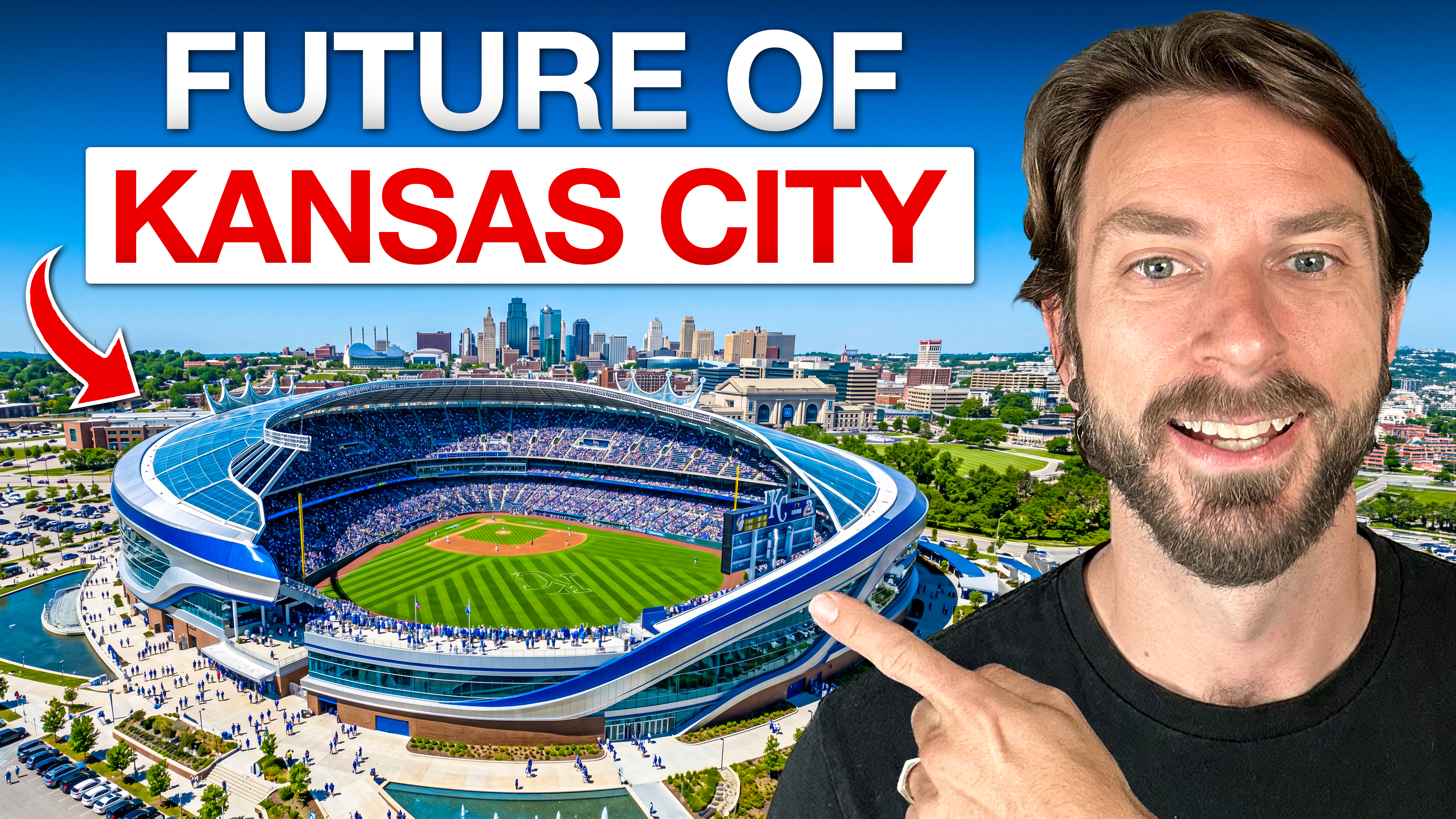
Table of Contents
- This Is the Biggest Deal in Kansas City History
- How We Got Here (It's Not the Story You Think)
- What the Deal Actually Includes
- Why Downtown Changes Everything
- The Coors Field Comparison
- What This Means for the Urban Core
- My Predictions
- What It Means for You
1. This Is the Biggest Deal in Kansas City History
The Kansas City Royals are building a new downtown ballpark. At Crown Center. An 85-acre mixed-use district with over $3 billion in phase-one investment — anchored by a $1.9 billion stadium — in the heart of the city.
And I don't think people fully understand yet what this means for Kansas City.
This is the biggest public-private partnership in Kansas City history. And it's landing at a moment when the urban core is already seeing more development momentum than it has in decades.
I'm Kyle — a licensed realtor here in Kansas City, and I've been covering how this metro is growing for years. In this post I'm going to walk you through how we got here, what this deal actually includes, why I think downtown baseball is the right call, and what it means for where Kansas City goes from here.
2. How We Got Here (It's Not the Story You Think)
To understand this announcement, you have to understand that this was not the original plan. This was the plan nobody could have drawn up — which is actually why it might be the best outcome.
In April 2024, Jackson County held a ballot vote: a new 3/8-cent sales tax extension over 40 years, designed to fund an Arrowhead renovation for the Chiefs and a new downtown ballpark for the Royals. The ask — depending on how you measured it — was somewhere between $1.7 and $2.2 billion from county shoppers, with additional city and state money still being negotiated on top. Voters said no. 58 to 42.
Honestly? The campaigns deserved to lose. The Chiefs showed up with an underwhelming renovation plan. The Royals' stadium site shifted late in the process. Community benefits agreements were an afterthought. It was one of the worst-run campaigns I've ever seen from two major franchises with a lot at stake.
After the vote, the Royals went quiet. But they didn't stop. They looked at North Kansas City. They looked at sites in Overland Park — but the Kansas door closed when the STAR bond proposal expired at the end of 2025. They looked at Washington Square Park as a downtown KC alternative.
And the whole time, something was happening behind the scenes that almost nobody knew about.
Royals owner John Sherman, Hallmark CEO Don Hall, and city officials had been building something. Don Hall said it himself at the press conference — standing in front of Liberty Memorial, with Union Station over his shoulder, he talked about what it meant to see baseball come back to the urban core where so much of KC's history was made. That wasn't a speech somebody writes the night before. That was years of trust being built between two institutions that care about this city.
The Crown Center announcement was the result of that.
And here's the broader context: I don't think Missouri was ever going to retain both teams. Kansas put roughly $2.4 billion in public support on the table for the Chiefs alone — with a ceiling above that in the detailed term sheet. No single county sales tax was going to match that.
But here's the thing — maybe that's actually the best outcome for this metro. Kansas City as a region didn't lose the Chiefs. The team plays 20 minutes from here. And Missouri didn't have to foot billions to retain both franchises. Instead, it gets to focus its investment on something that might actually do more for the urban core long-term. We're a two-state metro. Sometimes that's a complication. In this case, it might have been the advantage.
3. What the Deal Actually Includes
There's been a lot of loose numbers floating around, so let me walk through the structure.
The stadium: $1.9 billion total. That covers the ballpark, team offices, and infrastructure.
- 💰 Royals contribution: $800 million directly
- 🏙️ Kansas City: Up to $600 million through a TIF package — bonds backed by new revenue generated inside the stadium district, not existing city funds
- 🏛️ Missouri: Under the Show Me Sports Investment Act, roughly $450–$510 million over 30 years (per the Beacon's analysis), plus a possible $50 million in state tax credits. Not a final signed number, but the best public estimate available
Zoom out to the full picture: the broader Crown Center redevelopment in phase one is over $3 billion total, with roughly two-thirds coming from the Royals and private partners. On that denominator, the public share is around one-third.
For comparison: Kansas' public commitment to the Chiefs is roughly $2.4 billion — with a ceiling above that if all ancillary tiers are used. The Royals deal is smaller, more targeted, and cost overruns stay on the private side. That's a structurally different and more conservative public finance model.
The Hallmark piece is what makes this unusual. Hallmark is relocating its headquarters within Crown Center to make the site work — and committing to over $1 billion in private development alongside the Royals:
- 🏢 New Hallmark HQ
- 🏨 Retail and hotels
- 🌳 Parks and event space
- 📅 A 365-day activation model built around Washington Square Park and the existing Crown Center campus
The site: 27th Street south to Pershing north, Gillum west to Main east. 85 acres with room to expand. Connected directly to the KC Streetcar. Within a 10-minute walk of Union Station, the Liberty Memorial, the Crossroads, and Hospital Hill. Over 9,000 existing parking spaces in the immediate area.
Groundbreaking targeted for 2027. 20,000 construction jobs in phase one.
4. Why Downtown Changes Everything
Not everyone is celebrating. Missouri Workers is exploring legal options to force a public vote. Some council members have raised legitimate questions about TIF district boundaries and tax abatements. Councilman Johnathan Duncan has been publicly skeptical. Those concerns are real, and the deal still has to clear the TIF Commission with a 45-day public notice window, with the full development agreement going to city council for a final vote.
But here's something I think about whenever one of these announcements happens.
The academic literature on sports stadium subsidies is not flattering. Study after study has found that the promised economic multiplier effects tend to be overstated. Stadiums don't reliably lift regional GDP. The jobs created are often seasonal, part-time, and lower-wage. And the opportunity cost — what else could that public money have funded — is real.
I'm not dismissing those critiques. They're grounded.
But there's something those studies consistently struggle to measure: what it means to have a major league team in a mid-size market like Kansas City.
It's not just the direct economic activity. It's civic identity. It's why companies consider Kansas City when they're deciding where to put offices. It's why people who could live anywhere choose to stay. It's the thing that makes a city feel like a city rather than a place you pass through.
Ewing Kauffman understood this. He believed the Royals were worth more to Kansas City than any balance sheet could capture. That argument is harder to quantify — but it's not wrong.
And what's different about this particular deal is the downtown location changes the activation model entirely. A suburban stadium with a surface parking moat generates economic activity 81 days a year, mostly in a contained zone, mostly from people who drove there and drive home. A downtown ballpark woven into an existing urban fabric generates activity differently — it extends into the restaurants, bars, and neighborhoods around it, before and after every game.
That's the part the studies miss. And it's the part I think matters most here.
5. The Coors Field Comparison
I spent almost a decade in Denver. Watched that city transform in real time. And one of the anchors of that transformation — one of the things that helped turn LoDo into what it is today — was Coors Field.
The Rockies have been a disappointment on the field for most of their existence. Consistently one of the least competitive teams in baseball. Yet they still rank in the top third of the league in attendance almost every year.
Because going to a Rockies game in Denver isn't really about the Rockies. It's about being downtown on a summer night. You grab dinner in LoDo before the game. You walk over. You have a few beers, enjoy the skyline view, leave in the seventh inning, go out after. The game is almost beside the point.
That model works because the stadium is woven into the urban fabric — not sitting in a parking lot off an interchange that you drive to and drive home from.
I love Kauffman. The fountains, the setting, the tradition — it's a genuinely beautiful ballpark. But let me be honest about the experience: you drive out, you park, you go to the game, you drive home. There's no before-and-after in the same way. There's no neighborhood around it that pulls you in.
The Crown Center ballpark flips that. You take the streetcar down. You walk through the Crossroads on the way. After the game you're a five-minute walk from a dozen restaurants and bars. Union Station is right there.
And here's the thing that really matters for Kansas City specifically: the Royals have not been consistently great. Most years, you're not going because the pennant race is on the line. You're going because it's a Tuesday night in July and it's a nice night out. Downtown makes that decision easy in a way Kauffman never could. It stops being a baseball decision and starts being a downtown night out that happens to include baseball.
81 home games a year. Plus concerts, events, festivals, neutral-site games. That's year-round activation at the center of the city. Denver figured this out. Kansas City is finally getting there.
6. What This Means for Kansas City's Urban Core
The urban core of Kansas City has been losing population for decades. That's not a secret. The pattern of suburban growth pulling people outward — away from the center — is something Kansas City has been living with for a long time.
But something has been shifting. And it was already shifting before this announcement.
Downtown KC currently has around 32,000 residents — and at least seven high-rise projects are in predevelopment right now:
- 🏗️ Cordish Company's Four Light tower in the pipeline
- 🏗️ A 27-story tower at 14th and Wyandotte with 300 apartments
- 🏗️ A $300 million proposal for 700 residential units near 12th and McGee
- 🏗️ The South Loop Link park — a $217 million project expected to significantly increase development attractiveness in the surrounding corridor
These projects aren't happening because of the Royals announcement. They're happening because downtown Kansas City has been building momentum independently. But a $3 billion mixed-use anchor at Crown Center — connected to the streetcar, adjacent to Union Station and the Crossroads — accelerates everything around it.
Development follows activation. People follow development. That's the cycle this kind of anchor project kicks off.
Layer in a $1.5 billion Plaza redevelopment. The riverfront transforming with CPKC Stadium and the KC Current's new home. The West Bottoms being brought back to life with half a billion in development. All of these things are converging on the same geography within a few years of each other.
I've been saying for a while that Kansas City is at an inflection point. This announcement is the kind of thing that makes that inflection real.
7. My Predictions
The streetcar corridor between the Crossroads and Crown Center becomes one of the most valuable real estate corridors in the metro within a decade. Transit-oriented development follows rail investment — that's not a theory, it's a pattern. The streetcar was already changing things along Main Street. Add a $3 billion anchor at Crown Center with year-round activation and you've supercharged that trajectory. Properties within walking distance of that line are worth paying close attention to right now.
Downtown residential growth accelerates faster than people expect. The projects already in predevelopment were moving on their own timeline. A 365-day-activated ballpark district at Crown Center changes the demand calculus for everyone building in that corridor. More activation means more reason to live nearby. And 32,000 people in the urban core starts growing in a way this city hasn't seen in a long time.
The Royals' attendance story gets interesting fast. Put a mediocre team in a downtown ballpark connected to everything happening in Kansas City, and suddenly you're not just selling baseball. You're selling a summer evening in the city. I think you see meaningful attendance growth within the first few seasons — not because the team suddenly becomes a contender, but because the context around the game changes completely.
8. What It Means for You
Look — I grew up here, left for Denver, watched what happened to that city, and came back to Kansas City on purpose. I live in Brookside. I chose to move back to this city deliberately. And this announcement is confirmation of what I've been saying for years.
Kansas City has real momentum.
John Sherman said at the press conference: "There's no script for what we're sharing with you today." And he's right. This didn't happen the way anyone planned. It happened because two Kansas City institutions — the Royals and Hallmark — sat down and decided to bet on the city together. And because the city and the state finally figured out how to play their part.
There are still open questions. TIF boundaries. Community benefits agreements. Final council votes. I'm not glossing over those. But the direction is clear, and the momentum is real.
If you're thinking about moving to Kansas City — or you're already here and trying to understand what all of this means for where you live, where you buy, where the city is going — this is exactly the kind of context that matters. It's not just about finding a house. It's about understanding a city in motion.
👉 Head to movingtokc.net/info to connect with our team — whether you're three months out or three years out. And if you want the full picture on everything happening across the metro right now, check out this video linked right here.
|


or another way